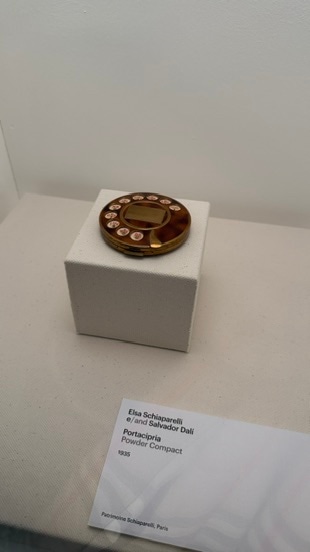
I stopped in front of a powder compact shaped like a telephone dial.
The label named Elsa Schiaparelli and Salvador Dalí.
I had come to Palazzo Reale with a fairly simple idea of Dalí. I thought of the painter. I did not expect to find him here, beside an object that could fit in someone’s hand.
I looked again.
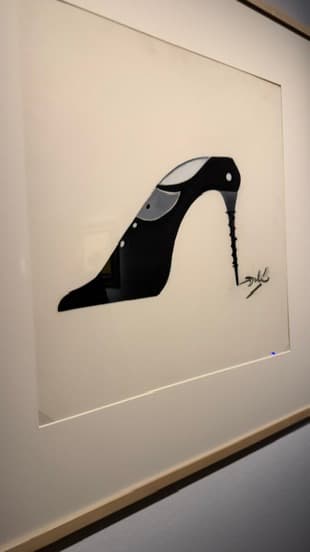
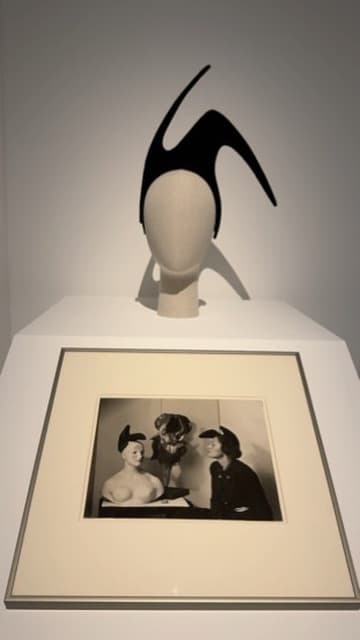
In another photograph I took, there is a drawing of a high-heeled shoe. Elsewhere, the shoe becomes a hat. Gala had photographed Dalí wearing a woman’s shoe on his head, and Schiaparelli and Dalí carried the image into her winter 1937–38 haute couture collection.
It is a playful object. It also asks you to reconsider a very ordinary one. The shoe is still recognisable, but it no longer does what you expect a shoe to do.
That shift feels close to what I love about Surrealism. You see one thing, then another possibility opens inside it.
From an image to a dress
I began to notice that the shoe-hat was not an isolated excursion.
Dalí’s lobster motif appeared on white organdy in a Schiaparelli dress from 1937. Cecil Beaton photographed Wallis Simpson wearing it, and the image appeared in Vogue. Across the more than 200 works and documents in Dalí e la Moda, there are magazine pages, garments, jewellery, photographs and objects. I stopped at a decorated Schiaparelli box and thought about packaging, too. Even before you open it, a box can make you feel that you are entering someone’s world.
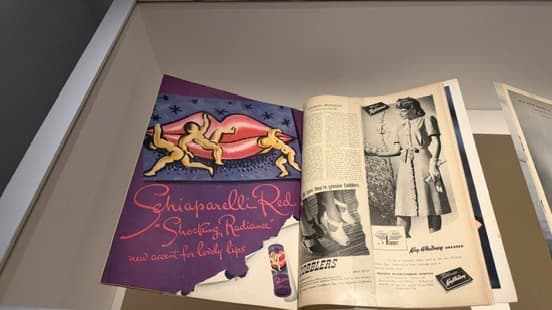
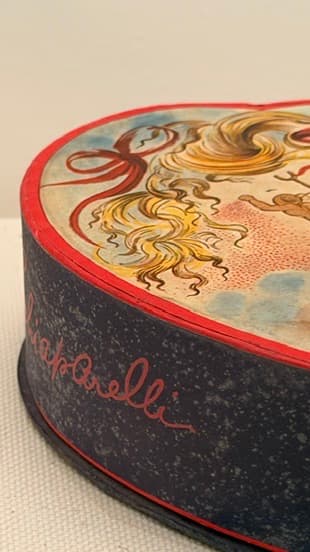
Each time, an idea had to change scale and material. A drawing could become something worn. Something worn could become an image seen by people far from the atelier. A small object could carry the same appetite for surprise as a painting.
Other people made these passages possible. Gala’s photograph became a starting point. Schiaparelli brought her own imagination and knowledge of fashion. Makers gave form to ideas that had to meet fabric, weight, fit and the body.
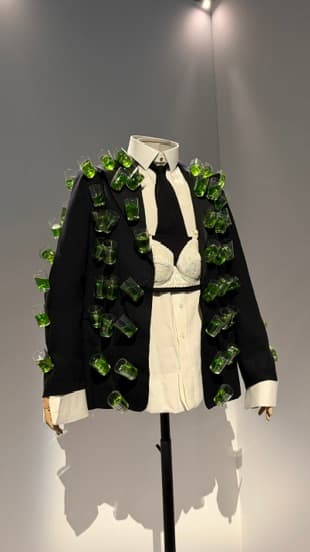
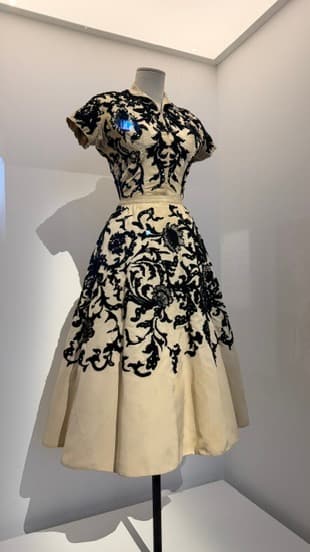
The more I looked, the less it made sense to ask which single medium belonged to Dalí. What seemed to travel was his way of seeing.
The thought I took home
On the way out, I began thinking about how we describe people now.
We are encouraged to choose a niche, define our positioning and make an Instagram bio understandable in seconds. I know why clarity matters. It helps people find our work.
But I wonder what happens when the description becomes a boundary. When a curiosity seems inconvenient because it does not fit. When we hesitate over a collaboration because we cannot yet explain what it might become.
Dalí’s life was exceptional; it cannot stand in for what was possible for everyone in his time. Still, the exhibition made me notice how readily I had reduced even him to the part I knew best.
I had thought of painting as the answer to what he did. I had not thought about the relationships that could take an idea into a garment, a magazine page or a powder compact. Looking back, those connections form a story. In the moment, each required a decision, another person, another possibility.
Perhaps that is what stayed with me most. We can have a direction without knowing every form our work might take. We can be recognisable without deciding that every future possibility must resemble the first thing we made.
I went to see Dalí the painter. I left wondering what else becomes possible when we stop expecting a person to remain only what we first knew them for.